Newsletter - May 2026
In this newsletter:
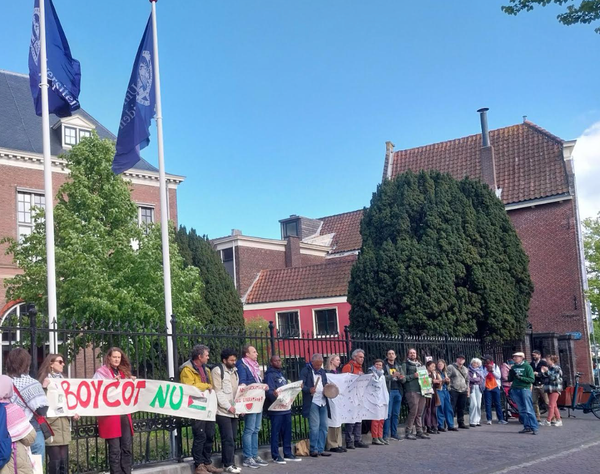
- Response to the CvB statement on ties with Israeli Institutions
- 11 May LSP Action Day!
- 19 May Community gathering: Palestinian Poetry, Music, and Food
- Open Letter: Beyond 'Pluralism': No Room for Genocide Denial Behind Closed Doors
- Looking back: Areej Sabbagh-Khoury
- Upcoming Events: Calendar
Response to the CvB statement on ties with Israeli institutions
The recent report by the Committee Human Rights and Conflict Areas on the collaboration between Leiden University and Israeli institutions marks a watershed, as it recommends ending the near totality of these relationships. Since the campaign for academic boycott began in earnest at Leiden in 2021, this is the first institutional recognition in the university that - as students and staff have repeatedly pointed out in articles, petitions, demonstrations, and occupations - Israeli institutions are structurally complicit in colonialism, apartheid, and genocide committed against the Palestinian people.
Despite acknowledging these realities, the committee stops short of drawing the full conclusions of its findings. It continues to limit its advice to case by case measures. Yet, if - as the committee found - Israeli universities are complicit in these crimes and therefore unsuitable partners, we therefore maintain that all relations with them should be halted, immediately, as a matter of course. To fail to do so can only serve as institutional cover for them.
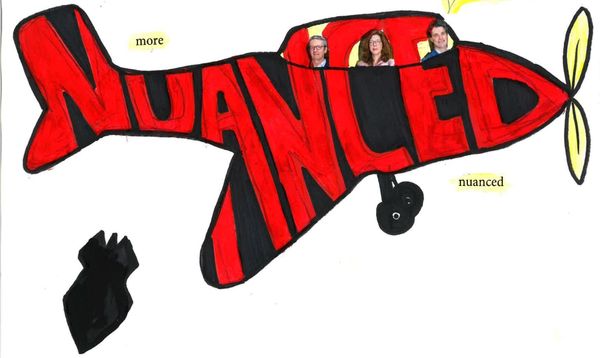
Worse still has been the reaction by the university’s CvB, which immediately put out a statement stating that they would not adopt the findings of the committee directly. The situation is more complex, they claim. And we will need to wait - wait again! - to hear what they do with this piece of research.
Two issues seem fundamental to us.
First, if it has been possible for Israel to commit a live streamed genocide in Gaza for over two years, and if they are now able to export its methods - indiscriminate murder, destruction of schools and universities, murder of journalists and political leaders, mass destruction of civilian infrastructure - to Lebanon and Iran, it is because the world continues to refuse to hold them accountable. Had our states and institutions heeded the academic boycott call in 2005 we would not be here today. We must hold those who commit these crimes against humanity accountable, in tangible ways, or be complicit in their impunity.
Second, both the university and the committee continue to approach this matter as one which concerns us primarily - as researchers and as a university. The broader societal issues, as for example those outlined briefly in this statement, the consequences of our actions for our counterparts in Palestine, Lebanon, Iran, etc., or the role of a university in a world in which states and politicians continue to sell off people’s lives so cheaply, remain out of the frame.
This report is a watershed because it is - finally - an acknowledgment of reality, when it comes to the institutional complicity of Israeli universities in the crimes of the Israeli state. It remains unfinished when it comes to taking action in response to this acknowledgment.
We would not be here today without the continuous mobilisation and pressure coming from students and staff. The formation of the committee, its findings, and their partial implementation have only been accomplished thanks to it. We therefore call on the Leiden community to maintain it and continue to demand an end to any collaboration under colonialism, apartheid, and genocide.
See our joint statement with SfP here
11 May LSP Action Day!
Monday 11 May 15:00-18:00
End academic complicity, cut the ties, take action against scholasticide.
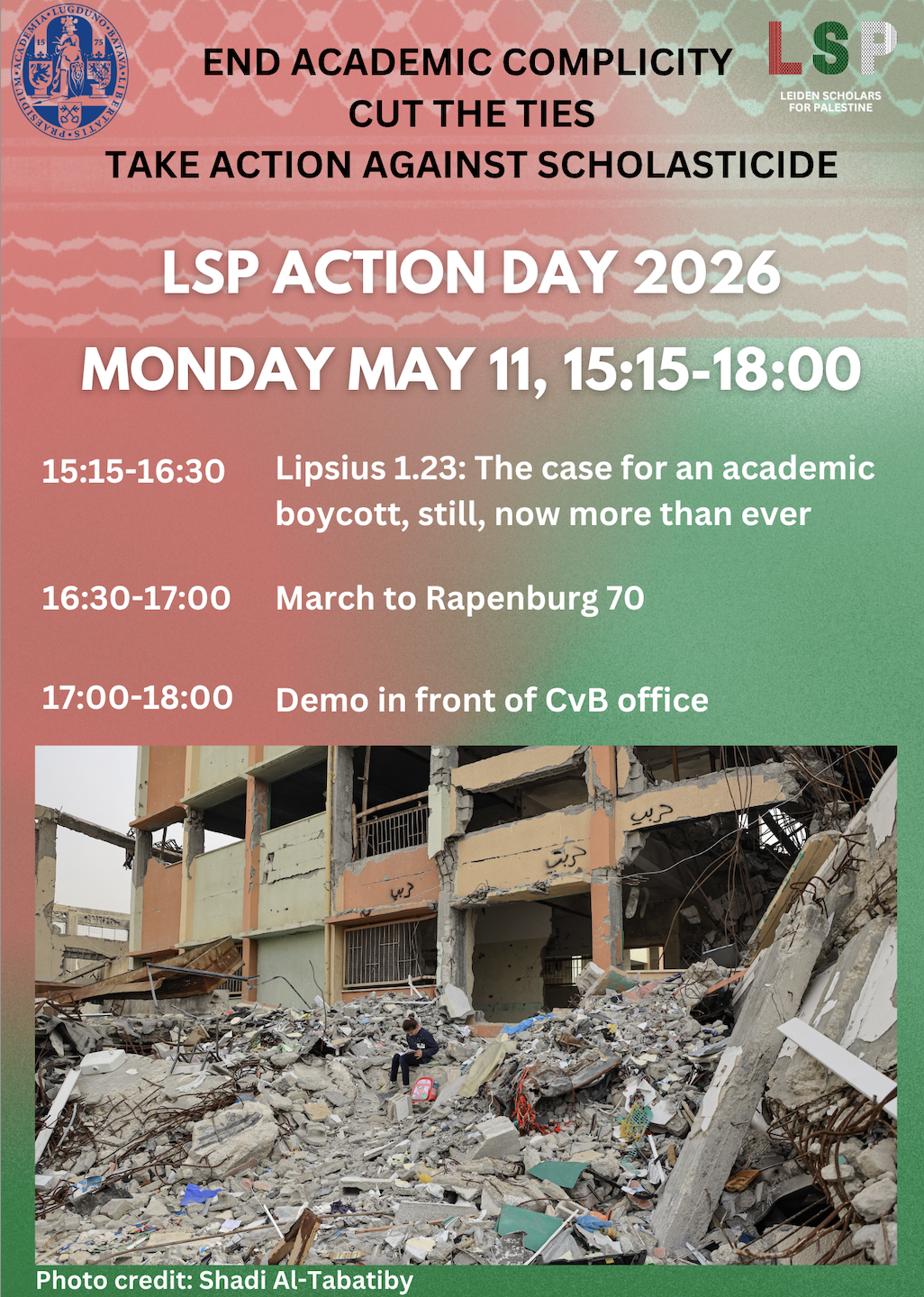
For 2.5 years, Israel has systematically targeted university infrastructure , students, and academics for elimination - in Palestine, of course, but also in Lebanon and Iran
Israeli universities are active participants in the state’s crimes and have been for 75 years.
Enough. We have one clear demand: cut the ties. Join us on Monday 11th May, for a panel discussion about the Committe’s report, the CvB response and why more action is needed to end complicity with genocide, human rights violations, and the murder of our counterparts in Palestine and beyond.
19 May Community Gathering: Palestinian Poetry, Music and Food
Leiden Scholars for Palestine will close the semester with a wholesome gathering filled with music, poetry and Palestinian snacks. Please join us on May 19, from 17:00-19:00 in Wijnhaven 3.60, The Hague.
Open Letter: Beyond 'Pluralism': No Room for Genocide Denial Behind Closed Doors
On May 7th, a closed-conference is scheduled to take place on the VU campus, with the title "The Risks of Weaponizing International Law". The description of the conference and the affiliations and prior work of the speakers, suggest that the aim of the conference is effectively to legitimise the genocide of Palestinians, despite conclusion of the UN Commission, rulings of the International Court of Justice and broad consensus amongst genocide scholars. To address this, concerned staff sent out a letter on April 17th to the executive board and FSG dean to demand a critical review of the event. Moreover, the event violates the VU rules regarding Israel/Palestine-related events by not being inclusive or transparent in virtue of being a closed-door conference. On April 30th, a reply was sent by the dean and the rector stating that they "see no grounds to reverse that approval based on the speakers and their topics" but that they will reach out to the organizers to enable registration by members of the VU community. Less than a week before the start of this conference this has not been followed up on and staff members requesting attendance have been rejected.
This highlights a recurrent and evident double standard: a conference that openly aims to legitimise genocide, war crimes and brutal violations of human rights, by bending legal definitions is permitted, while staff and students advocating for Palestinian rights face repression, police violence and intimidation. Events and actions by Palestinian advocacy groups are repeatedly suppressed under the veil of "pluralism" while violence towards Palestinian groups and activists given a platform and legitimised.
Since the responsible boards have failed to take action concerned staff and students call to 1) sign an open letter to demand that the conference is cancelled, and 2) attend a counter-event on May 7th: a demo against the conference at 9am and then a counter-conference at 10am (location will be announced)
Looking back: Areej Sabbagh-Khoury
On April 15, Dr. Areej Sabbagh-Khoury presented her book Colonizing Palestine to a large audience of engaged students and staff at Leiden University. Her book examines the formation of settler-colonial hierarchies in Mandatory Palestine and the crucial role played by socialist Zionism in shaping the conditions that culminated in the 1948 Nakba. Drawing on a meticulous and historically grounded analysis of eight Zionist and Israeli archives—examining two periods, from the mid-1930s to the 1950s and from the 1970s to the 1990s—the book traces how practices of domination, dispossession, and territorial control were developed, institutionalized, and normalized over time.
Challenging conventional narratives that portray the socialist Zionist left as a force of coexistence, the book demonstrates how this political tradition was deeply implicated in the consolidation of settler-colonial logics. By examining the material and symbolic mechanisms of land appropriation, population transfer, and legal-political governance, Colonizing Palestine reveals how the structures established during this formative period continue to shape the sociopolitical landscape of Israel/Palestine today—including enduring patterns of dispossession and resistance.
Specifically, through her focus on material practices of colonial dispossession and expulsion, and associated meaning making processes, Dr. Sabbagh-Khoury’s book talk emphasized how the structural nature of settler colonialism is not limited to the settlement process, but is a dialectical outcome of colonial ideology and practice. In this regard, she also stressed the importance of re-centering the development of the Zionist colonial project from a traditional emphasis on its European origins to a study of the material practices of territorial control and colonial expansion on the ground, which started before the 1948 Nakba, with the destruction of tens of Palestinian villages by the Zionist movement in the 1930s. Engaging with concrete practices of domination and dispossession, and how they change over time to advance the settler colonial project, Dr.Sabbagh-Khoury argued, is crucial to address anti-colonial resistance in Palestine, its historical development, and its prospects today.